How much does a concrete driveway cost in Brisbane?
The cost of a concrete driveway in Brisbane depends on the size of the area, the slab thickness and reinforcement, how much site preparation the ground needs, and the finish you choose. No two driveways are the same. The most reliable way to know your price is a site-specific quote.
I’m David Bunce, owner-operator at Bunce Concrete and Construction. I’ve spent more than 18 years pouring concrete across South East Queensland, and I hold an Advanced Diploma in Building Construction and QBCC licence #15372237. Below I explain the factors that move the price, so you can plan your budget before you ever pick up the phone.
What affects the cost of a concrete driveway?
Every driveway is different, and pricing reflects the specific requirements of your project. Some of these factors you can see from the street. Others only show up once we assess the ground. Here are the main ones.
Size and shape
The total area in square metres is the biggest cost driver. A standard two-car driveway is roughly 40–60 square metres. Curved driveways, wider entry points, or extended lengths all increase the total area, so they lift the overall cost.
Shape matters too. A simple rectangle is quick to form up and pour. Curves, garden cut-outs and awkward angles take more time in the formwork stage, and that time is part of the price. If you want to see the full range of driveway work I take on, my concrete driveway services page shows the finishes and layouts I build most often.
Thickness
Standard residential driveways are typically 100mm thick. Areas that carry heavier loads may need 125mm or more. A thicker slab uses more concrete and more steel, so it costs more, but it also handles weight without cracking. If you park a caravan, a boat trailer or a work ute on the drive, the extra thickness is worth it.
Reinforcement
Steel mesh and rebar reinforcement is essential for any driveway that carries vehicle weight. The type and density of reinforcement depends on expected loads. A driveway that occasionally takes a delivery truck needs more steel than one used only for family cars. Cutting corners here is the fastest way to end up with a cracked slab, so I never do it.
Site access and excavation
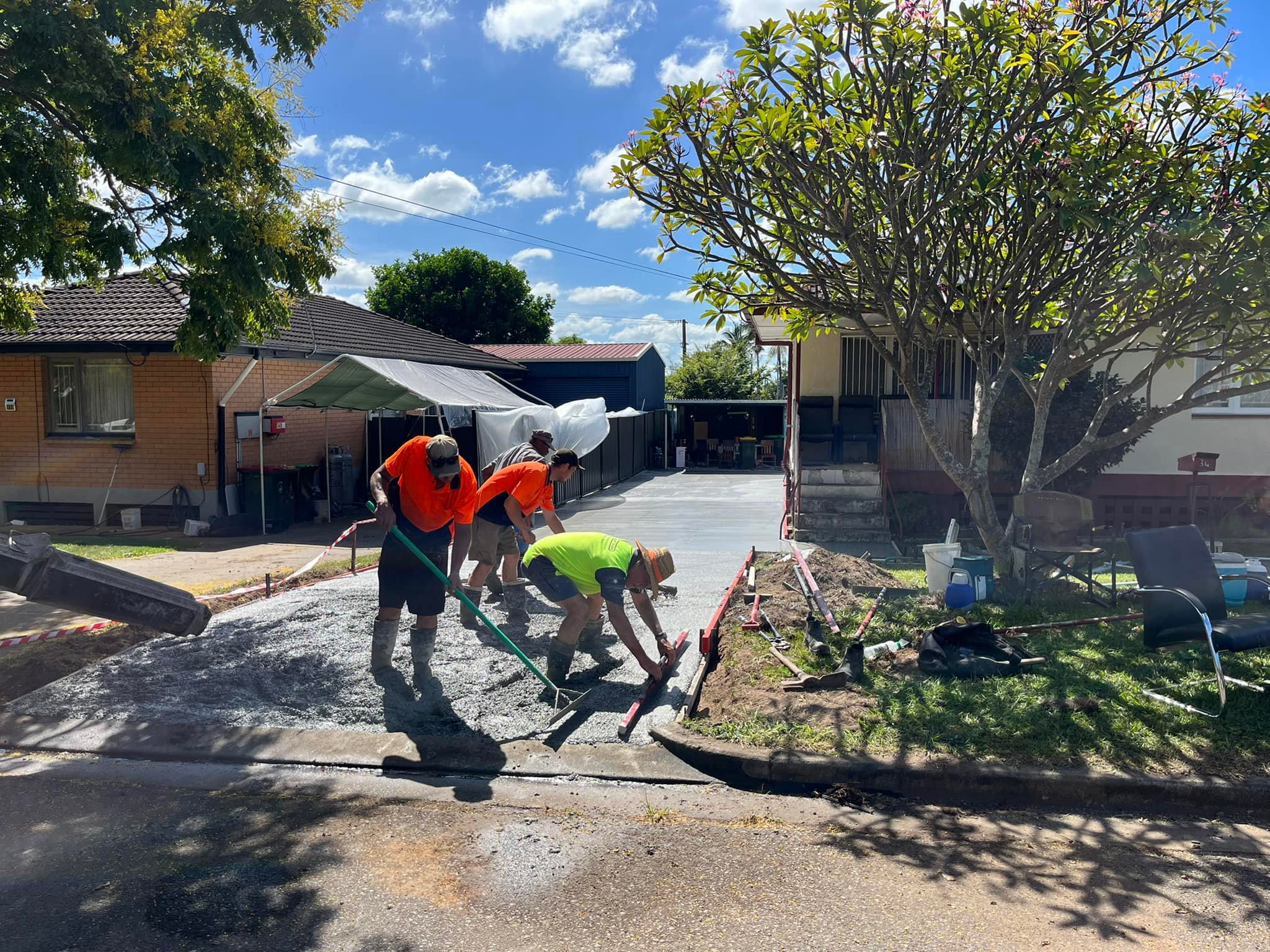
Access to your property has a real impact on cost. If a concrete truck and equipment can reach the pour area easily, the job runs quickly. If the site is tight, sloped or behind the house, I may need to barrow concrete by hand or bring in extra gear. That takes time and labour.
Excavation is the other half of this. The area needs to be dug out to the right depth and the spoil carted away. Steep blocks, tree roots and rocky ground all add to the excavation stage. Much of South East Queensland sits on reactive clay, which needs careful preparation so the slab stays stable through wet and dry seasons.
Soil and site preparation
Before any concrete goes down, the ground has to be right. That means levelling, compacting and laying a proper base of road base or crushed rock. Poor preparation is the hidden cause of most driveway failures, so this stage is not the place to save money.
Reactive clay soils, common across Logan and Ipswich, move as moisture changes. A driveway built on unprepared clay can lift, sink or crack within a few years. Getting the base and drainage right at the start protects the slab for decades.
Removing an old driveway
If you already have a driveway, the old surface usually has to come out first. Breaking up and removing existing concrete, asphalt or pavers adds labour and disposal costs to the project. A thicker or steel-reinforced old slab takes more effort to remove than a thin one. When you ask for a quote, let me know what is already there so I can price the removal accurately.
Drainage
Brisbane gets heavy summer downpours, so water has to go somewhere. A driveway needs the right fall and, in some cases, drainage points or channel drains to stop water pooling against your slab or running towards the house or garage. Adding drainage works to the scope increases the cost, but it protects both the driveway and your home. I always assess drainage on site rather than guessing.
Concrete finish
The finish you choose has a significant impact on price. In rough order from most affordable to most premium:
- Plain concrete (broom finish) is the most cost-effective option and still gives a tough, low-maintenance surface
- Coloured concrete adds pigment through the mix for a custom look at a modest step up in price
- Exposed aggregate reveals the natural stone for a textured, slip-resistant finish and sits in the mid-to-upper range
- Stamped concrete and stencil concrete create decorative patterns and cost more again because of the extra work involved
- Honed and polished concrete are premium smooth finishes at the top of the range
The finish is where personal taste meets budget. Plain concrete does the job for many homes. A decorative finish lifts the look of the whole property, and plenty of my clients decide the extra spend is worth it once they see the result.
How to get an accurate quote
The best way to understand what your driveway will cost is to get a site-specific quote. Online calculators and per-metre averages only get you so far, because they can’t see your ground, your access or your drainage.
Here is how my quoting process works:
- You get in touch and tell me the rough size, location and what you have in mind.
- I visit your property, measure up and assess the ground conditions, access, slope and drainage.
- We talk through your preferred finish and thickness for the way you’ll use the driveway.
- I send you a detailed written quote that covers everything, with no hidden extras.
Every quote from Bunce Concrete includes:
- Site preparation and ground works
- Formwork installation
- Concrete supply and placement
- Reinforcement suited to your loads
- Your chosen finish
- Curing and aftercare guidance
- Full clean-up
To speed things up, have a few details ready before I visit: the approximate size of the area, whether an old driveway needs removing, how you’ll use the driveway, and any finish you’ve seen and liked.
Where I work across South East Queensland
I’m based in the Logan area and I pour driveways across Logan, Ipswich, Brisbane Southside and the Northern Gold Coast. Because I know the soils and council requirements in these areas, I can prepare sites correctly the first time. You can see the full list of suburbs I cover on my service areas page.
Being a local, fully insured, owner-operator means you deal with me from the first quote to the final clean-up. That’s part of why I’ve earned 4.9 stars from 37 Google reviews.
Is a concrete driveway worth the investment?
A well-built concrete driveway lasts 25–30 years or more with minimal maintenance. Compared with pavers, which can shift and need re-levelling, or asphalt, which degrades in Queensland heat, concrete offers the best long-term value for most homes.
It also adds genuine kerb appeal and property value, and that’s something buyers notice the moment they pull up. When you factor in the low upkeep over its life, a concrete driveway is one of the more sensible improvements you can make to a South East Queensland home.
Ready to get a quote?
Call me on 0450 404 518 or request a free quote online. I’ll visit your property, assess the ground, talk through your options and give you a straightforward written price. No pressure and no obligation.
David Bunce
Owner of Bunce Concrete & Construction with 18+ years of concreting experience and an Advanced Diploma in Building Construction. David personally manages every project across Logan, Ipswich, Brisbane Southside, Northern Gold Coast.