Concrete driveway drainage solutions for Queensland homes
Good driveway drainage starts with the fall. Water should run away from your home and off the slab within seconds, not pool against it. In South East Queensland, where a single storm can drop 100mm, the right grade and drains protect both your driveway and your foundations.
Why Queensland rain is hard on driveways
South East Queensland does not get gentle, steady rain. We get long dry spells, then intense summer storms that dump a month of rain in an hour. Logan, Ipswich and the Brisbane Southside all sit in this pattern. When that much water hits a large flat surface at once, it has to go somewhere.
A driveway is one of the biggest hard surfaces on most blocks. Rain cannot soak through concrete, so every drop runs across the surface until it finds an edge or a low point. If the driveway sheds that water towards your home, garage or a neighbour’s fence, you have a problem. Standing water also sits on the slab, works into any hairline cracks and shortens its life.
Good drainage is not an afterthought. We plan it before the first form board goes in.
Start with the fall
The single most important drainage feature costs nothing extra: the fall. Fall is the slope built into the slab so water runs off under gravity. Get it right and you may not need much else.
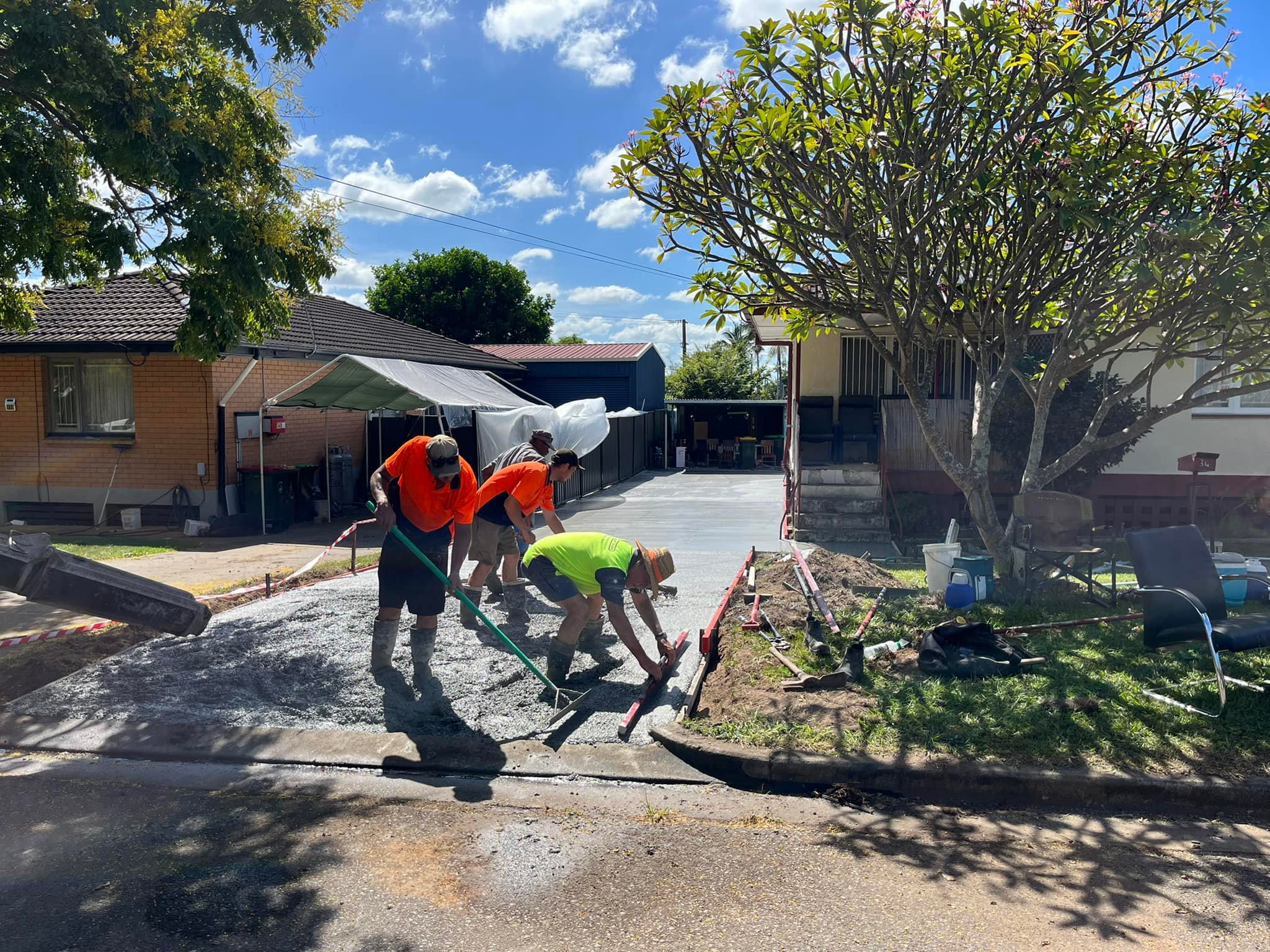
As a rule, a driveway should fall at least 1 in 100 – that is 10mm of drop for every metre. For a driveway that catches a lot of water, we often build in more. The fall should always carry water away from the house and towards the street, a garden bed or a drain.
Cross-fall matters too. On a wide driveway, we may crown the middle slightly so water sheds to both sides, or fall the whole slab one way to a channel. Every site is different. Because I have spent 18 years pouring concrete across Logan and South Brisbane, I read the natural slope of your block first, then design the fall around it.
Channel drains for driveways that catch water
Sometimes fall alone is not enough. If your driveway runs downhill towards the garage, or the block is tight and water has nowhere to go, we install a channel drain, also called a strip drain.
A channel drain is a long, narrow grate set flush into the concrete. It sits across the low point – often at the garage door or the bottom of a sloped driveway – and catches sheeting water before it reaches the house. The water drops into the channel and pipes away to a legal discharge point.
Channel drains do the heavy lifting on steep blocks. They are neat, they carry a lot of water, and the grates come in finishes that suit a modern home. We size the channel to the catchment, so it copes with a real Queensland downpour, not just a light shower.
Spoon drains and low-impact options
Not every driveway needs a covered channel. A spoon drain is a shallow, dished channel formed into the concrete itself. It looks like a smooth gutter running along the edge of the driveway, and it guides water gently to where you want it.
Spoon drains work well along the side of a driveway or beside a concrete pathway, carrying runoff to a garden or the street. They have no grate to clog and no moving parts. For many homes, a well-placed spoon drain plus good fall is all the drainage a driveway needs.
Surface finish plays a part as well. A textured finish such as exposed aggregate concrete gives better grip when the surface is wet, which matters on any driveway that slopes. It is a popular choice for exactly that reason.
Some councils also want new hard surfaces to manage stormwater on site rather than pushing it all to the street. There are a few ways to do this.
We can leave planted or gravel strips between concrete wheel tracks, so part of the rain soaks into the ground. We can direct runoff into a rain garden or a soak well sized for your soil. On larger jobs, we grade the driveway so overflow feeds a landscaped swale.
The right mix depends on your soil, your slope and your council’s rules. Ipswich, Logan and Brisbane each have their own requirements. We plan drainage that meets them and still looks the part.
Protecting the slab and the house
Drainage is really about protecting two things: the slab you paid for and the home behind it.
Water that pools on concrete finds its way into small cracks. In our climate it then bakes in the sun and swells again with the next storm. Over years, poor drainage turns a hairline crack into a real one. Water running towards the house is worse again. It can undermine foundations, flood a garage or leave a damp problem you cannot see until it is serious.
Every driveway we pour is fully reinforced, laid at the right thickness and drained to carry water away from your home. I am QBCC licensed (licence 15372237), hold an Advanced Diploma in Building Construction and carry full insurance, so the job is done properly and backed. Homeowners across Logan, Ipswich, the Brisbane Southside and the northern Gold Coast have rated our work 4.9 stars from 37 Google reviews.
If you are planning a new concrete driveway, or an existing one floods every wet season, we can fix the fall and the drainage at the same time.
Book a driveway drainage assessment
Water problems only get worse if you leave them. Whether you are in Springwood or anywhere across our South East Queensland service areas, I will visit your property, check the fall, and design drainage that keeps water off your slab and away from your home. Request a free, no-obligation quote through our contact page and let’s sort it out before the next storm.
David Bunce
Owner of Bunce Concrete & Construction with 18+ years of concreting experience and an Advanced Diploma in Building Construction. David personally manages every project across Logan, Ipswich, Brisbane Southside, Northern Gold Coast.