How long does concrete take to cure? A Queensland guide
You can usually walk on new concrete after 24 to 48 hours. You can drive a car on it after 7 days. It reaches full strength at about 28 days. Those are the headline numbers. In Queensland’s climate the exact timeline shifts with heat, humidity and rain, so let me explain how it really works.
The short answer
- Walking on it: 24–48 hours
- Placing light items on it: 48–72 hours
- Driving a car on it: 7 days minimum
- Full strength: 28 days
These are general guidelines. The actual curing timeline depends on the mix design, thickness, and – critically in Queensland – the weather conditions.
Setting, drying and curing are not the same thing
People often use these three words as if they mean the same thing. They don’t, and the difference matters when you plan your project.
Setting is the first stage. The concrete goes from a wet, workable mix to a firm surface. This happens within a few hours of the pour. Once it sets, footprints and tool marks no longer show.
Drying is simply water leaving the surface. A slab can feel dry to the touch and still be nowhere near strong enough to use.
Curing is the chemical reaction that gives concrete its strength. Cement and water react in a process called hydration. This reaction keeps going for weeks, long after the surface looks and feels dry.
Here is the part that surprises most homeowners. Concrete does not need to dry out to get strong. It needs to stay moist so hydration can continue. If a slab dries too fast, the reaction stops early and you lose strength. That is why my curing methods focus on holding moisture in, not drying the concrete out.
After 18 years in the trade, this is the single point I most want clients to understand. A slab that looks finished on day 2 is still fragile. Patience over the first month protects the work you have paid for.
How Queensland weather affects curing
Heat and humidity
South East Queensland’s warm, humid climate actually presents specific challenges for concrete curing:
- Hot days (above 30°C) can cause the surface to dry too quickly, leading to surface cracking. We manage this by adjusting our pour times – starting earlier in the morning during summer – and using curing compounds to retain moisture.
- Humidity can slow surface drying but doesn’t significantly affect the internal curing process. In practice, our humid conditions are generally favourable for curing.
Rain
Light rain after the initial set (usually 4–8 hours after pouring) is actually beneficial – it keeps the surface moist and supports the curing process. However, heavy rain during or immediately after pouring can damage the surface finish.
This is why we monitor weather forecasts closely and reschedule pours if heavy rain is expected. Your finish quality is never worth the risk.
Winter
Queensland’s mild winters (typically 10–20°C) are actually ideal curing conditions. Cooler temperatures slow the curing process slightly, which generally produces stronger concrete. We rarely need to take the cold-weather precautions required in southern states.
How I cure your concrete on site
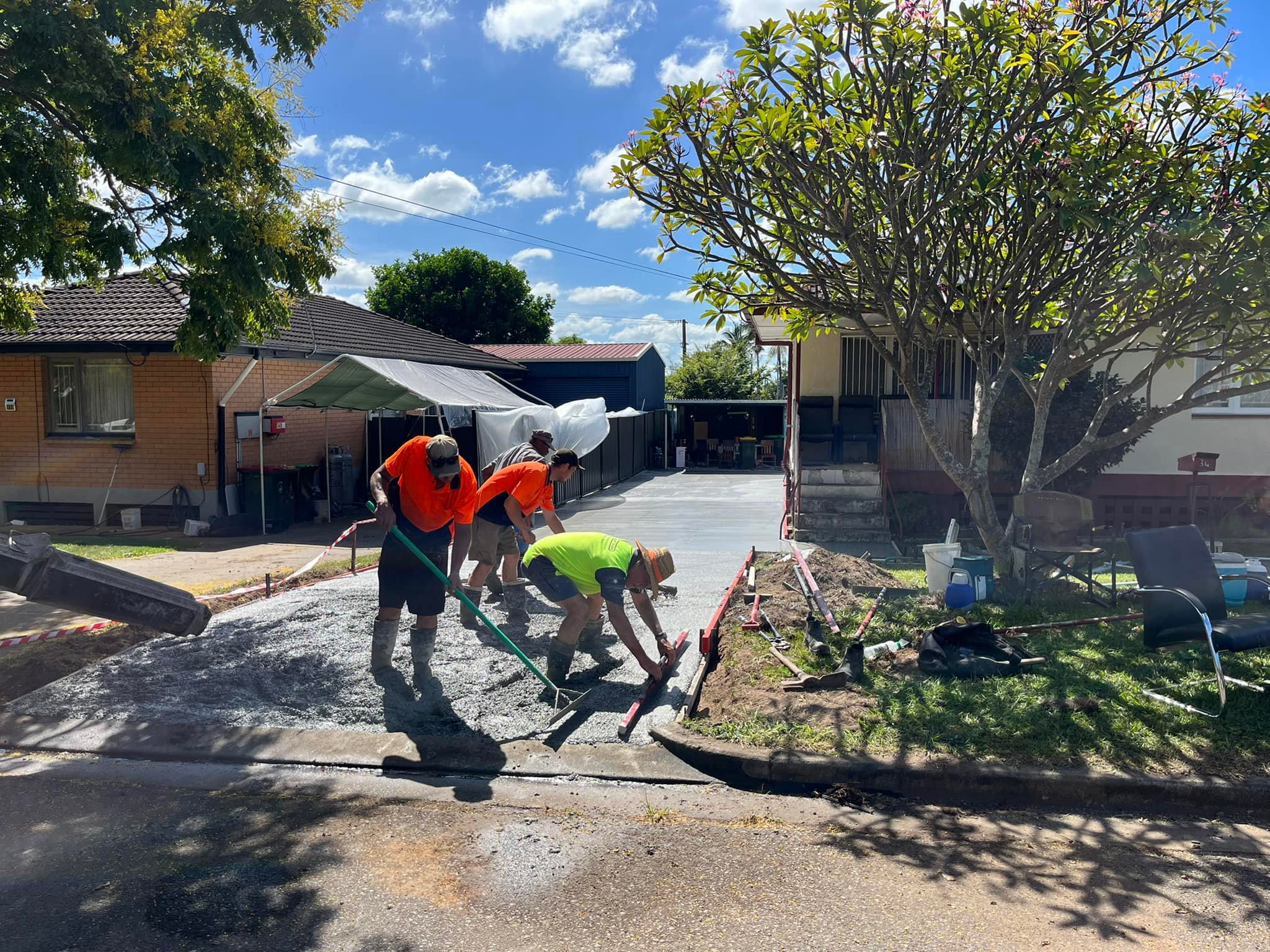
Good curing is not luck. It is a set of deliberate steps I take on every job across Logan, Ipswich, Brisbane Southside and the northern Gold Coast. Here is what happens after the pour.
Moisture retention. The goal is to keep water in the slab while hydration does its work. In hot weather I may cover the surface, mist it, or start the pour early in the day to beat the afternoon heat. On a large shed slab I plan the timing around the forecast so the surface never dries out too fast.
Curing compounds. I apply a curing compound at the time of the pour. This forms a thin membrane over the surface that slows evaporation. It does the same job as days of hand watering, more evenly and more reliably. For a concrete driveway that will carry vehicle loads for decades, this consistency is worth it.
Control joints. Concrete moves as it cures and as the ground temperature changes. Control joints are the grooves you see cut into a slab. They tell the concrete where to crack, so any shrinkage cracking happens in a straight, hidden line rather than across the middle of your driveway. I place and space these joints based on the slab size and thickness. On structural foundations the joint layout and steel reinforcement are planned together, because those slabs carry building loads.
Reinforcement and thickness. Steel mesh or bar does not speed up curing, but it works with the curing process to control cracking and carry load. The right thickness and the right steel are set before a single barrow is poured.
All of this is covered by my QBCC licence (number 15372237) and full insurance. It is also the reason my work has earned 4.9 stars from 37 Google reviews.
Tips for the first 28 days
After we finish your pour, here’s what you can do to support the curing process:
-
Keep it moist – if you see the surface drying out in hot weather, a light spray with a garden hose helps. We apply curing compounds at the time of the pour, but extra moisture in extreme heat doesn’t hurt.
-
Avoid heavy loads – no vehicles for at least 7 days, no heavy machinery or skip bins for 28 days.
-
No sharp turns – when you do start driving on it, avoid turning your steering wheel while stationary for the first month. This can scuff the surface.
-
Avoid chemicals – don’t use any chemical cleaners, sealers, or treatments during the first 28 days unless we’ve specifically recommended them.
-
Be patient with colour – if you’ve chosen coloured concrete, the final colour may take a few weeks to fully develop as the curing process completes.
When to seal your concrete
For most finishes, we recommend sealing after the 28-day curing period. Sealing protects the surface from staining, water penetration, and UV damage. Exposed aggregate and honed concrete in particular benefit from regular resealing every 3–5 years.
We can advise on the best sealer for your specific finish and application. Sealing before the slab has cured traps moisture and can cloud the finish, so timing matters as much as the product.
What to expect if it rains or heats up mid-job
Queensland weather changes fast. If a storm rolls in after your pour, you may worry the job is ruined. In most cases it is not. Once the surface has set, a shower helps more than it hurts. I plan every pour around the forecast, and I will reschedule rather than risk your finish.
If a heatwave hits during your first week, keep the slab damp with a light hose spray in the morning and evening. You cannot overwater curing concrete. What harms it is letting the surface bake dry. My advanced diploma in building construction taught me the theory behind this, and 18 years on the tools taught me how it plays out on a real driveway in a Logan summer.
Questions about your pour?
If you’ve got a project coming up and want to understand the timeline, or if you’ve recently had concrete poured and have questions about curing, get in touch through my contact page or call me on 0450 404 518. Tell me the job, your suburb and your timeframe, and I’ll walk you through exactly what to expect week by week.
David Bunce
Owner of Bunce Concrete & Construction with 18+ years of concreting experience and an Advanced Diploma in Building Construction. David personally manages every project across Logan, Ipswich, Brisbane Southside, Northern Gold Coast.