How reactive clay soils affect your concrete slab
Reactive clay soils swell when wet and shrink when dry. That movement can lift, crack or twist a concrete slab that was not designed for it. In South East Queensland, the fix is a proper soil classification under AS 2870, then a footing and slab engineered to match the ground.
Why South East Queensland soils move so much
Much of Logan, Ipswich and the Brisbane southside sits on clay. Clay is reactive soil. It draws in water and swells through our wet summers, then dries out and shrinks over winter and through drought. That cycle lifts and drops the ground under your slab, sometimes by tens of millimetres across a single season.
Anything that wets one side more than the other makes it worse. A garden bed against the edge, a downpipe with no drainage, a slow plumbing leak – each keeps one part of the ground swollen while the rest dries and pulls away. The uneven movement is what cracks concrete, not the movement on its own.
If you have seen a driveway split in a straight line after a dry spell, or a shed slab lift at one corner, reactive clay is usually behind it.
What AS 2870 site classifications mean
AS 2870 is the Australian standard for residential slabs and footings. Before I pour any foundation, the block is classified by a soil test. A geotechnical tester bores the ground and reports how reactive it is.
The classes run from stable to extreme:
- Class A – stable sand or rock, very little movement.
- Class S – slightly reactive clay.
- Class M – moderately reactive clay or silt.
- Class H1 and H2 – highly reactive clay.
- Class E – extremely reactive clay.
- Class P – problem sites, including soft ground, uncontrolled fill or poor drainage.
Most blocks around Logan and Ipswich land between M and H. That is normal for our region. It does not stop you building. It just means the footing and slab have to be designed for that ground, not guessed at.
How soil movement cracks a slab
Concrete is strong under compression but weak in tension. When reactive clay swells under the middle of a slab and drops away at the edges, the slab is forced to bridge the gap. The underside goes into tension and cracks open. Builders call this doming.
The reverse also happens. In a long dry spell the edges shrink and drop while the centre stays supported. The slab dishes, and cracks appear across the top. That one is called edge heave.
Fine hairline cracks in concrete are normal and harmless. The cracks that matter are the ones that keep widening, step at the edges, or leave one side sitting higher than the other. Those point to ground movement, and they are far cheaper to prevent than to repair.
How I design and build around reactive soils
After more than 18 years on the tools, and with an Advanced Diploma in Building Construction, I treat the ground as the most important part of any pour. Here is how I manage reactive clay.
Start with the soil classification. Every structural slab I build begins with a site classification under AS 2870. An engineer then uses that report to design the footing and slab. I build to that design – I do not swap my own guess for an engineer’s numbers.
Stiffen the slab with edge beams. On reactive sites the slab is thickened around the perimeter and along internal lines into deep edge beams. These beams give the slab the stiffness to ride over ground movement instead of cracking with it. The more reactive the soil, the deeper the beams.
Reinforce to the design. Steel does the work concrete cannot. I place the mesh and any trench bars exactly where the drawings call for them, at the correct height in the pour, with the right cover so the steel never sits exposed. Correct reinforcement is the difference between a slab that flexes safely and one that fails.
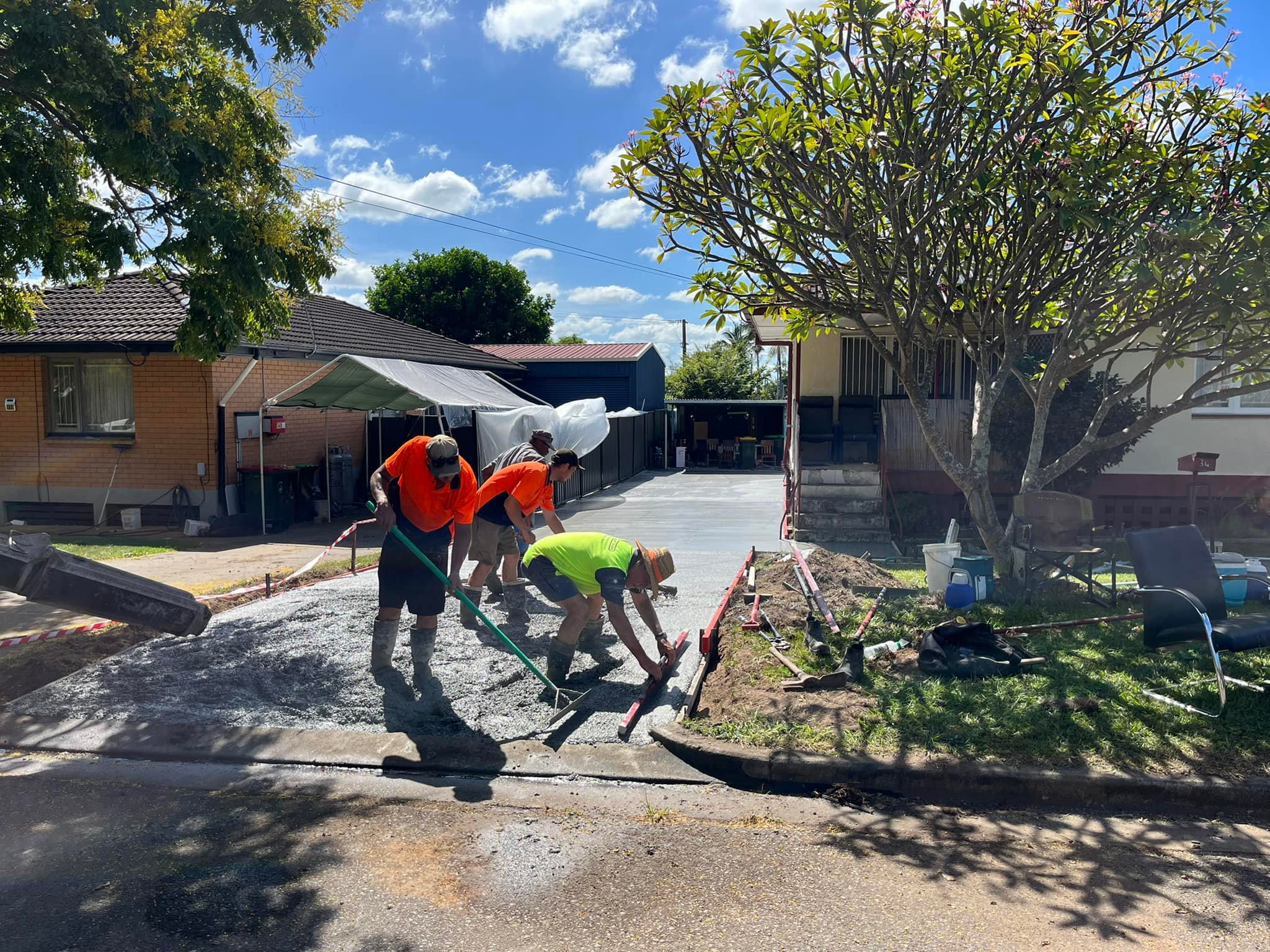
Manage moisture around the slab. Because water drives the movement, I pay close attention to the edges. That means good fall away from the slab, drainage for downpipes, and a plastic membrane under the pour. Keeping the ground moisture even is half the battle. This matters just as much for a concrete driveway or a shed slab as it does for a house foundation.
Where a block slopes or the ground needs holding back, a properly engineered retaining wall and footing keeps soil and water where they belong, which protects the slab as well.
Does every job need a soil test?
Structural work does. A house slab, a granny flat or a large concrete foundation needs classification and engineering, and often certification too. A path or a small domestic slab may not need a formal report, but I still build it with the same respect for the ground.
I work across Logan, Ipswich, the Brisbane southside and the Northern Gold Coast, from concreting in Springwood and Daisy Hill out through the wider service area. The soil changes from street to street, so I never assume. Fully insured and QBCC licensed (licence #15372237), I would rather spend a little more getting the base right than watch a slab crack in its first summer. That care is part of why clients rate our work 4.9 stars from 37 Google reviews.
Book a slab that is built for our soil
If you are planning a slab, driveway or foundation anywhere across Logan and South East Queensland, let me assess your ground before anything is poured. Call me, David Bunce, on 0450 404 518, or book a site inspection and quote, and I will talk you through the right footing design for your block.
David Bunce
Owner of Bunce Concrete & Construction with 18+ years of concreting experience and an Advanced Diploma in Building Construction. David personally manages every project across Logan, Ipswich, Brisbane Southside, Northern Gold Coast.